THE JOURNAL
PISCES: On the Nature of Biography Work
INTRODUCTION TO ISSUE 1 / SUMMER 2026
Dear Student of the Invisible,
We are pleased to introduce PISCES: On the Nature of Biography Work.
While we recognize this is just a start, equally we honor this very significant moment. From seeds planted nearly two years ago, perhaps ages ago in our biographies, with humility, we welcome the budding forth of this publication and look forward to watching it bloom, especially as we connect with readers and any number of contributors in the future. We hope you will enjoy it, learn from it, and help us make it better.
Speaking of making it better: Recently, we’ve been working with the question of how to make writing experiential. It is one thing to include experience from the writer, but our question is about how to provide the reader with an experience. Clearly others can really do this, others who set an impossibly high bar! We’re talkin’ Wendell Berry, Toni Morrison. Those whose writing changes the reader.
We are inspired by Stephen Harrod Buhner who challenges writers to ensoul language. We find this akin to what anthroposophical circles call etheric or living thinking. Just as one can hear and feel the difference between talking about a subject and talking out of living experience or real love of a subject, sensitive readers know when they are reading something ensouled or living.
If ever there were a subject that called for ensouled and living writing, biography work is it!
We admit we have a long way to go. We and our work and this issue are far from perfect, which is making us crazy. To get to publication, we have had to slay some dragons: layers upon layers of doubt and fear. We have had to “kill darlings” as Stephen King puts it: those sentences or whole paragraphs we think are oh-so-clever but do not work. We have had to move past every sort of obstacle and distraction within and without, from our boundaryless want of comfort to that closet that needs cleaning out. And how could it be otherwise? Any meaningful creative work will lead to questioning oneself. We have met this: We have felt we can’t possibly pull this off or do it justice or even sustain the necessary energy. Any meaningful creative work will ask more than one is prepared to give. We recommend it.
There is a form here that we intend to carry forward: featured articles of some length; brief recurring columns, such as Let’s Talk About the Christ, Speaking of Karma, and Charting the Archetype; a reflection on the biography of an individual—this time, Maria de Zwaan, and going forward inspiration from Maria’s way of working will be a recurring column as well; each issue will highlight an artist or poet who is also a biography worker.
We will never want for content On the Nature of Biography Work. Making choices will be the challenge. While in the future we may dedicate an issue to a theme, such as suffering or money, this issue is composed of that which came toward us and appeared somehow foundational. We are making a start and hope you will join us in developing ever greater understanding of this phenomenon we love: biography work. There issomething new under the Sun!
Altogether this journal is the fruit of countless conversations, many belonging to circles of biography workers with whom we are privileged to associate. Our deepest thanks to all our colleagues. A special thanks to contributors Asra Zahn, Lauren Hakala, and Sarah Putnam, who have been both patient and generous.
Warmly, and with gratitude,
Leah and Cindy
June 2026

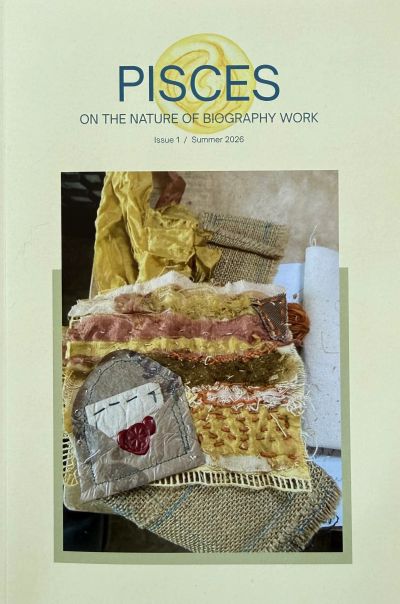
Metanoia by Cindy Sas
Prayer to One’s Angel (or Genius) by E.K. Plachner
You my heavenly friend, my angel, who has led me to the earth and who will lead me through the gate of death into the spirit-home of the human soul, You who knows the paths since millennia, do not cease to enlighten me, to strengthen me, to advise me, so that I may emerge from the weaving fire of destiny as a strong destiny vessel and fill myself ever more with the meaning of the divine world goals.
A group of seven biography workers—the Heartland Circle—have used this Prayer to One’s Angel (or Genius) as our opening and closing verse almost from our beginning, over ten years ago. Meeting monthly, that means we have taken it in rhythmically more than 200 times.
Recently I was reading it to begin a prayer time and the phrase “strengthen me” lit up. Suddenly I realized that, in all those times of hearing it, I had always thought of it as “give me strength.” I saw myself as a passive and greedy recipient of whatever strength my angel was willing to send my way.
But that day I heard it in a completely new way, as: “Send me the experiences I need in order to build strength within myself.” I felt invited to look at the experiences I tend to dislike and wish to avoid—the screaming pain of sciatica that comes seemingly out of nowhere; the difficulties in relationships; the frustrations, grief and anger of living in a world that seems to have gone mad—as opportunities to be strengthened in body and soul.
This also reflects a shift in perspective that may arise with aging: We can grow from being helpless children who need (and expect?) the spiritual world to protect us and provide for all our needs, toward the maturity of adulthood where we take responsibility for how we perceive, respond to, and interact with, the world and the cosmos, while also recognizing that we are human and do stand to benefit from the wisdom and guidance that our angel can provide, if we will but ask for help.
Such shifts in perspective are metanoia: change of heart and mind. Biography work facilitates metanoia.
The Human Meeting by Leah Walker
Speech arose because clairvoyance was lost. – Karl König
Once, the human being was universally clairvoyant and, in this way, existed in a truly social condition without spoken language. Mineral, plant, animal, human being, celestial being—spirit in all its forms—were perceived, known, communed with. Then, long ago, and over a long period of time—the full course of Atlantis—this clairvoyance receded and language emerged. These are correlated phenomena: a natural knowing—once flowing invisibly and inaudibly between human beings and between human beings and their surroundings—diminished, and language slowly took its place. Clairvoyance dimmed and the human being learned to communicate in a new way.
The awakening of language led to the formation of states in Atlantis. “Society arises out of language, but it developed—take this as a picture—because the heavens withdrew their wisdom. What was lost reappears as social life on the basis of language.”[1]The human being was granted freedom, and the greater the freedom, the greater the need for organizational structures and explicit agreements to live by. Peace among humankind will arise when “an understanding is gained of the new spirituality that fills the society, the community life of human beings.”[2]
Put another way: If we were clairvoyant—if we were in possession of a natural and complete knowing or understanding—we’d have no need to talk with one another, no need for formal organizational structures, such as laws. But we are currently without such natural understanding; instead, we have dialogue, conversation.
And, we are heading for clairvoyance again: “Humanity as a whole is beginning to cross the threshold.”[3] And being on our way, we are thrashing through “the way it is” trying to get to how we feel or sense it could be. We long to be heard, seen, understood. We long for harmony and struggle to understand why it is so elusive. Such potential waits for us to develop the social chops. Waits for us to know conversation is our salvation. Waits for us to awaken to the new spirituality.
[1] Karl König, Becoming Human: A Social Task, The Threefold Social Order (Floris Books, 2011), 85.
[2] König, Becoming Human, 85.
[3] Rudolf Steiner, The Problems of Our Time, GA 193, Lecture 1; 12 Sep 1919, Berlin.